Selecting the appropriate wheel hub for heavy-duty trucks, construction machinery, agricultural equipment, and specialized trailers is fundamental to ensuring operational safety and efficiency. Unlike passenger vehicles, off-highway vehicles operate in complex, variable environments that place extreme demands on a hub's strength, durability, and fitment precision. Incorrect selection can accelerate tire wear, increase fuel consumption, and—in severe cases of overloading or stress concentration—lead to catastrophic failures like blowouts or axle fractures.
This guide provides a professional selection framework tailored for the global market, integrating core parameters, application-specific advice, material comparisons, and maintenance protocols, all while incorporating relevant industry standards and terminology.
I. Core Principles: Safety and Precision First
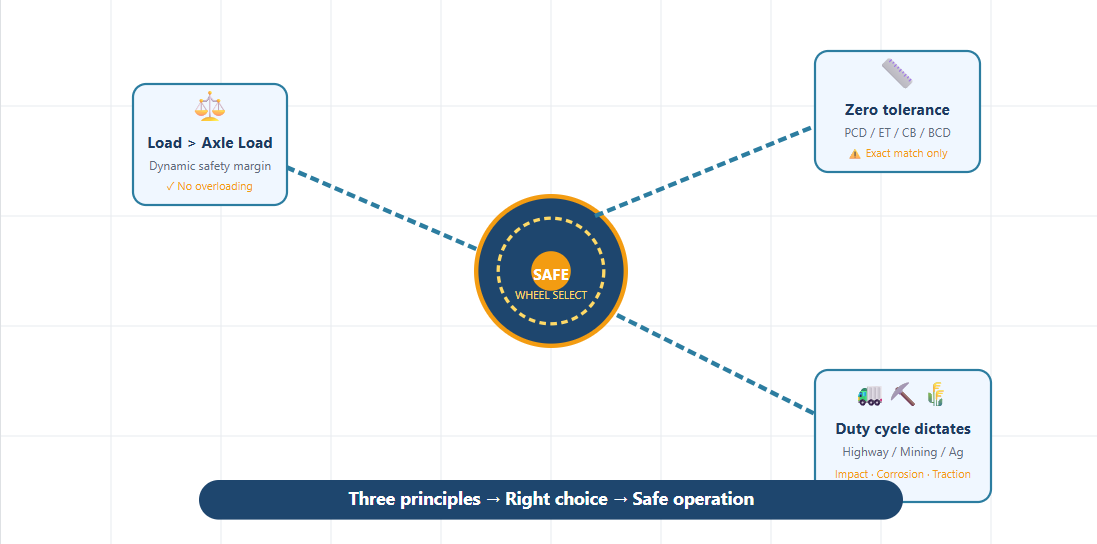
When selecting hubs for off-highway applications, adhere to these three foundational principles:
Load Capacity is the Bottom Line: The hub’s rated load capacity must exceed the vehicle’s maximum actual axle load with a sufficient safety margin. This is the primary defense against structural failure.
Zero Tolerance for Geometric Mismatch: Installation geometry must precisely match the original axle or OEM specifications. Even microscopic deviations can alter stress distribution, leading to premature fatigue damage.
Application Dictates Design: There is no universal "best" hub. Scenarios ranging from mine haul roads to paved highways and deep paddy fields require distinct design solutions.
II. Key Parameters: 7 Critical Data Points to Verify
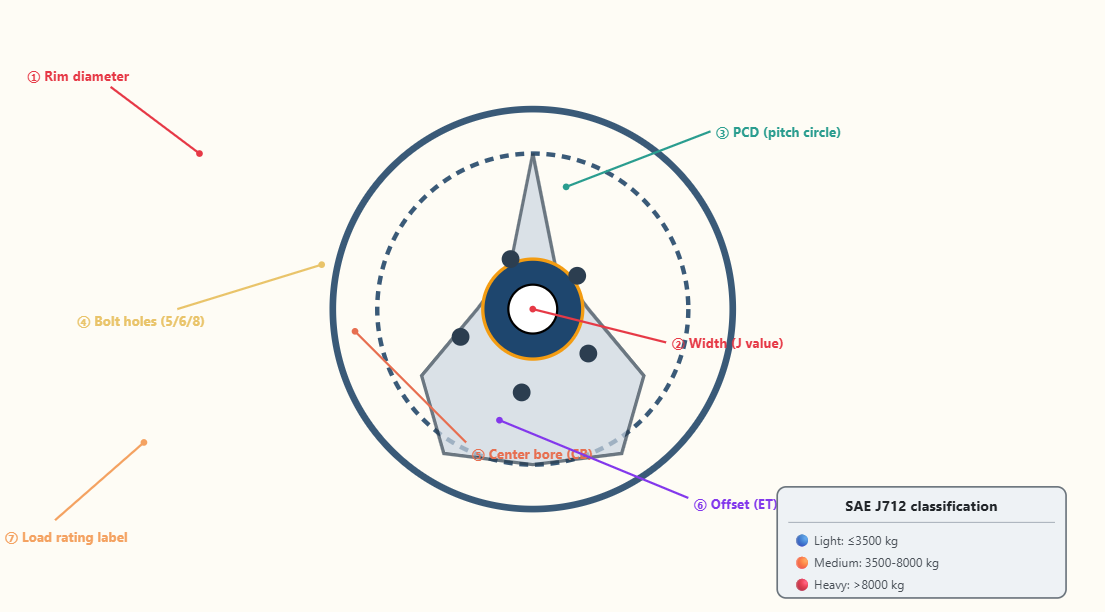
Before procurement, verify these seven core parameters against the original vehicle or axle identification plate to ensure compatibility and safe load-bearing.
Parameter | Definition & Function | Matching Requirement |
|---|
Rim Diameter | Determines compatible tire size (e.g., 22.5-inch rim for 11R22.5 tires). | Must exactly match the original specification (in inches). |
Rim Width (J Value) | Influences tire section width and contact area, directly affecting load capacity. | Must fall within the tire manufacturer's approved width range. |
PCD (Pitch Circle Diameter) | Diameter of the bolt hole circle; determines physical mounting feasibility. | Must be an exact match (e.g., European 335mm vs. American 285mm are incompatible). |
Bolt Hole Number & Spec. | Critical for clamping force and safety; common configurations are 8 or 10 holes for heavy loads. | Count, thread specification (e.g., M22x1.5), and grade must correspond. |
Center Bore (CB) | Centralizes the hub on the axle and shares shear load. | A new hub's center bore can be slightly larger, but differences >2mm require high-precision centering rings. |
Offset (ET Value) | Distance from mounting face to rim center; affects track width and steering geometry. | Deviation from OEM ET should ideally be kept within ±10mm to avoid suspension interference. |
Rated Load | Maximum safe load per individual hub. | Formula: (Max Axle Load ÷ Wheels per Axle Side) × 1.2 (Safety Factor). Result must be ≤ Hub Rating. |
Note (Standards Integration): For agricultural tractors, refer to the SAE J712 grouping standard (e.g., common Group 5 hubs: 8-bolt, 203.2mm PCD). This ensures global interchangeability.
III. Application-Specific Selection Guide
1. Truck Hubs: Efficiency vs. Durability
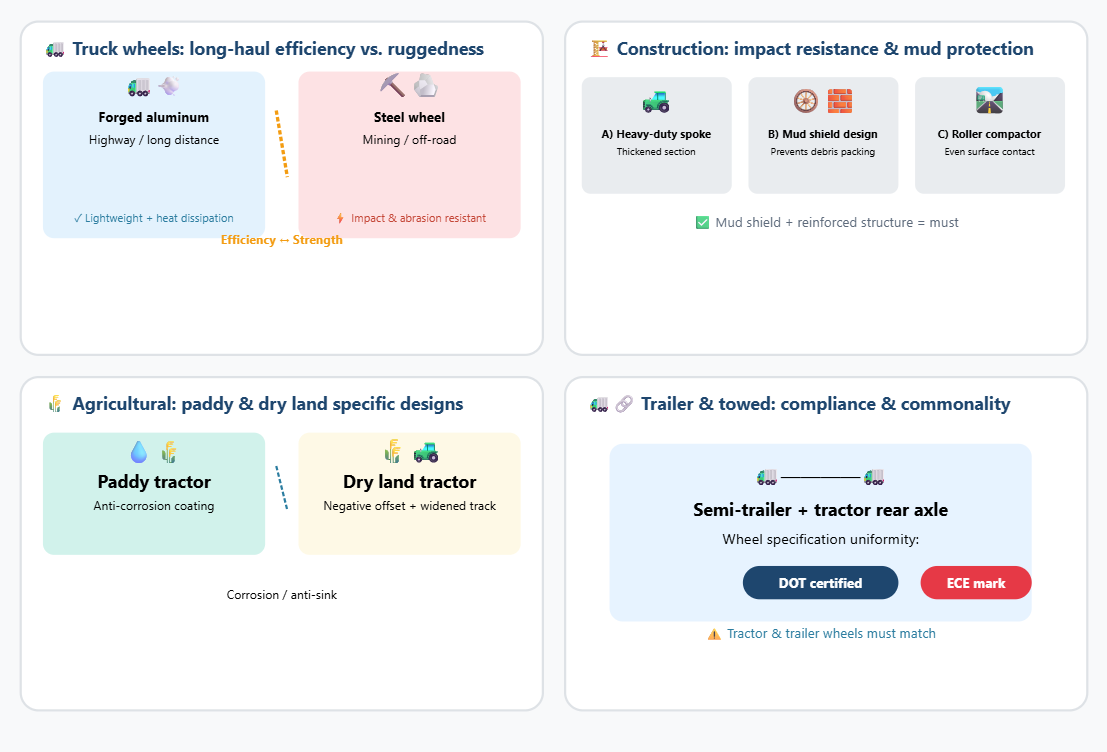
Line-haul / Long-distance Tractors: For fuel economy and low TCO, forged aluminum hubs are preferred. They offer 30-50% weight reduction over steel, superior heat dissipation (reducing blowout risk), and higher true-running accuracy. Common specs: 22.5×8.25 and 22.5×9.00.
Dump Trucks / Mining Haulers: Subjected to unpaved terrain and impact, high-strength steel hubs remain the standard due to exceptional deformation resistance and cost-effectiveness. Wide-base rims (e.g., 22.5×11.75) distribute heavy load pressure.
2. Construction Machinery: Impact Resistance & Design
Loaders/Excavators: Require thickened-spoke, heat-treated alloy steel hubs with reinforced flange edges to withstand rock strikes.
Muddy Conditions: Opt for large ventilation openings or integrated mud guards to prevent soil buildup and vibration.
Road Rollers: Demand extremely high true-roundness and balance to ensure uniform compaction.
3. Agricultural Vehicles: Terrain & Standards
4. Trailers & Semi-trailers: Compliance & Interchangeability
Semi-trailers: Ideally, hub specs (diameter, PCD, holes) should mirror the tractor's drive axle. This facilitates tire swaps and aids compliance with regulations like DOT certification (US) and ECE R124 (Europe).
Heavy Specialized Trailers: Multi-axle, dual-tire, or quad-tire layouts require strict single-wheel load calculation and dedicated Heavy Duty hubs.
IV. Material Comparison: High-Strength Steel vs. Aluminum
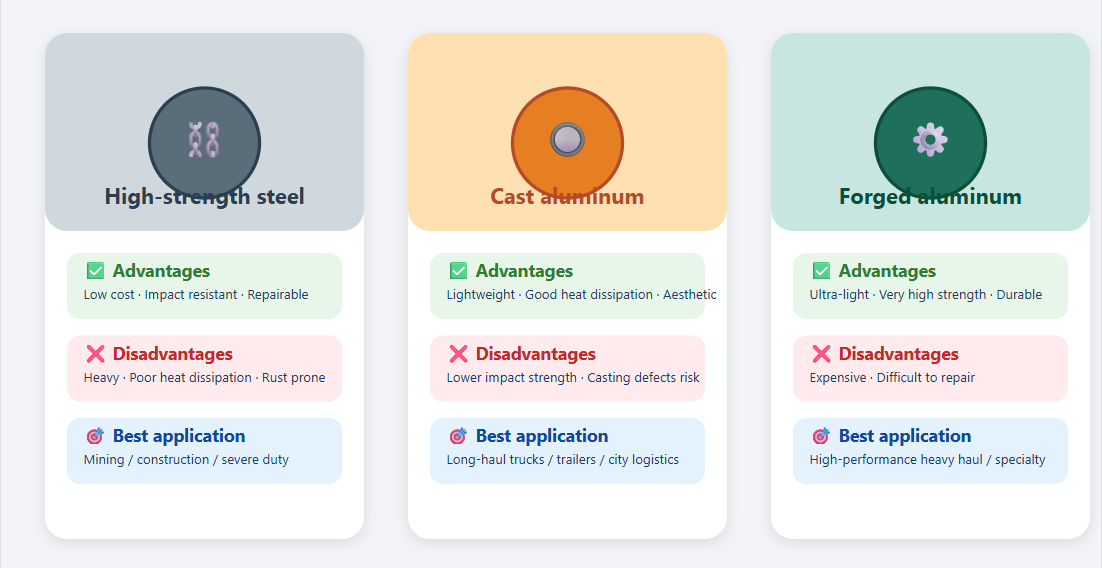
Feature | High-Strength Steel Hub | Cast Aluminum Hub | Forged Aluminum Hub |
|---|
Pros | High impact resistance, lower cost, repairable | Lightweight, excellent heat dissipation, corrosion-resistant | Best strength-to-weight ratio, superior fatigue life |
Cons | Heavy, poor heat dissipation, prone to rust | Higher cost, potential brittle fracture under extreme impact | Premium price, longer lead times |
Best Use | Rough terrain, mining, short-haul heavy loads | Highway transport, urban delivery, balanced TCO | Premium fleets, racing, high-value special equipment |
V. Installation & Maintenance: Ensuring Long-Term Safety
Correct installation is as critical as correct selection:
Standardized Mounting: Use a torque wrench. Adhere to the manufacturer's specified torque and star-pattern tightening sequence. Under-torquing causes loosening; over-torquing stretches bolts.
Mandatory Balancing: Perform dynamic balancing post-installation. Imbalance induces resonance, damaging bearings and suspension.
Periodic Inspection: Align checks with service intervals (~5,000 km or monthly). Focus on:
Summary
Hub selection for off-highway vehicles is a precise engineering task. Prioritize the sequence: Verify Geometry > Calculate Load > Match Application. When data is incomplete, consult OEM manuals or authorized service centers. By integrating international standards (SAE, DOT, ECE), this guide supports global fleet managers and technicians in identifying safe, efficient, and compliant hub solutions.
Cuntact us,please visit:CONTACT US-Dongying Rungold Co., Ltd/.
If you are interested in our radial tires, please visit: https://www.rungold.net/.
If you are interested in our all-steel radial truck tires, please visit: https://greamarkotr.com/.