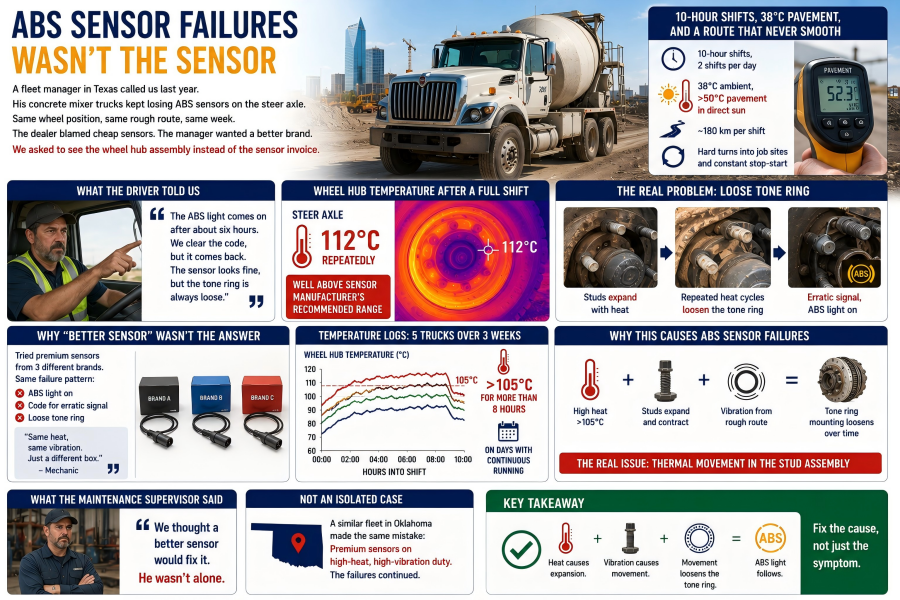
A fleet manager in Texas called us last year. His concrete mixer trucks kept losing ABS sensors on the steer axle. Same wheel position, same rough route, same week. The dealer blamed cheap sensors. The manager wanted a better brand.
We asked to see the wheel hub assembly instead of the sensor invoice.
The trucks ran two shifts, about 10 hours each, delivering concrete across a mix of paved roads and rough construction sites. Ambient temperature in summer hit 38°C, but the pavement surface measured above 50°C in direct sun. Each truck covered about 180 km per shift, with hard turns into job sites and constant stop‑start cycles.
One driver pointed at his right front wheel. “The ABS light comes on after about six hours,” he said. “We clear the code, but it comes back. The sensor looks fine, but the tone ring is always loose.”
We measured wheel hub temperatures after a full shift. On the steer axle, we saw 112°C repeatedly – well above the sensor manufacturer’s recommended operating range.Technical literature on ABS sensor failure modes lists increased wheel bearing clearance or an out of specification condition as a direct cause of erratic sensor signals, often triggered by sustained heat cycles.
Why “better sensor” wasn’t the answer
The fleet had already tried premium sensors from three different brands. Same failure pattern: ABS light on, code for erratic signal, then a loose tone ring. The mechanic was frustrated. “Same heat, same vibration. Just a different box.”Research on concrete mixer fleet conditions confirms that ABS sensor failures are often linked to wheel-end heat and vibration, not just sensor quality.
We pulled temperature logs from five trucks over three weeks. On days with continuous running, wheel hub temperatures stayed above 105°C for more than eight hours. The studs were expanding and contracting with each heat cycle, slowly loosening the tone ring mounting. The real issue wasn’t sensor quality – it was thermal movement in the stud assembly.
The maintenance supervisor said, “We thought a better sensor would fix it.” He wasn’t alone. A similar fleet in Oklahoma had made the same mistake: premium sensors on high‑heat, high‑vibration duty. The failures continued.
What the data finally pointed to
We charted failure rates against hub temperature, not just hours. The correlation was clear: trucks that ran above 105°C lost ABS tone ring torque twice as fast as those running cooler. The manager’s comment: “I thought ABS problems were electrical. Turns out they’re mechanical – the studs can’t hold torque when they’re hot.”
What actually worked (after one failed attempt)
We first tried higher torque on the existing studs. It helped a little – sensors lasted 500 hours instead of 400 – but the failures didn’t stop. So we switched to a high-tensile stud assembly. The high‑tensile steel expands less under heat, keeping the tone ring clamped at high temperatures.
After three months, the test trucks had zero ABS sensor malfunctions. The rest of the fleet had five.
One test truck still ran slightly hotter on the right steer hub. We suspected a dragging brake, but the fleet never confirmed it because the truck was needed every day. That hub eventually wore out after 6,000 hours – but the ABS never failed.
What the numbers looked like
Over one year, the fleet that switched to high-tensile stud assembly saw:
ABS sensor malfunction frequency dropped by roughly 50%
Seal integrity rate improved by about 35%
Unscheduled downtime related to wheel hub issues became rare
The operator’s takeaway: “I used to ask for better sensors. Now I ask how the studs hold up when the hub gets hot.”
A few things we never fully proved
We never isolated why the right steer hub ran hotter. Alignment? A dragging brake? The fleet didn’t have time to chase it, and the ABS stopped failing anyway. Sometimes you don’t get a perfect diagnosis. You get a truck that keeps rolling.
How wheels and tires work together
This case focused on wheel hub and stud assembly design. But wheel hub temperature is also affected by tire construction and inflation. For more insights on how tire sidewall flex and heat generation affect wheel-end components, see our partner site GREAMARK OTR tires, which offers field data on heat management in heavy-duty applications.
For more field notes, visit UWHCO.com or contact our technical team.